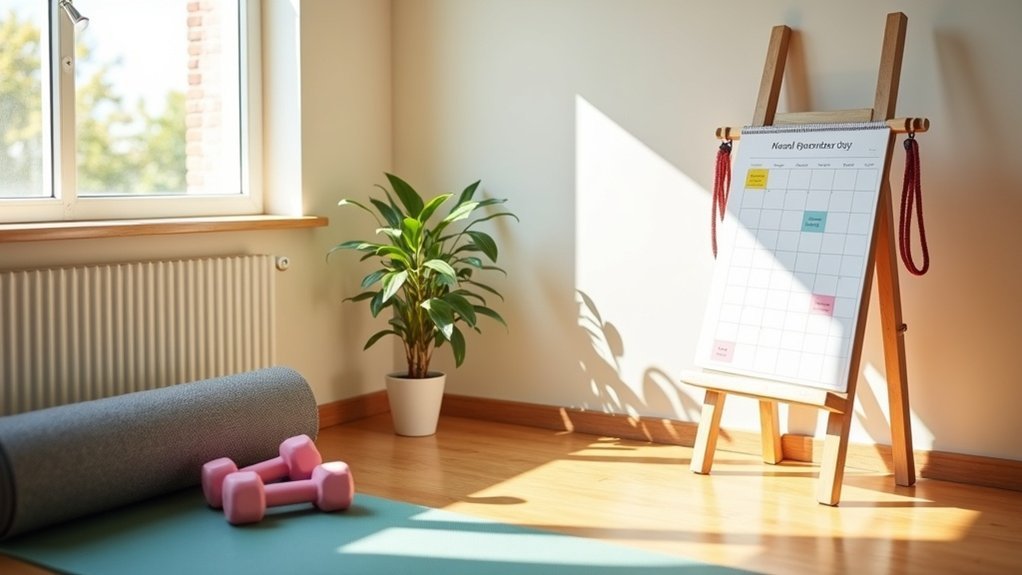
To create a weekly training plan with limited home gym equipment, start by evaluating your fitness level and setting realistic goals using the SMART method. Design full-body workouts three times a week that incorporate compound exercises like squats and push-ups, which can be performed with minimal gear. Structure your sessions with a mix of high and low rep sets, focusing on maintaining proper form and technique. Keep track of your progress to adjust your workouts as needed and stay motivated. Explore the best exercises that suit your home environment and available equipment for optimal results, ensuring you stay healthy and fit from the comfort of your home.
Key Takeaways
- Create a full-body workout schedule at least three days a week, focusing on compound exercises that engage multiple muscle groups, using minimal home gym equipment.
- Utilize bodyweight exercises, resistance bands, or a weighted vest to introduce variety and challenge into your workouts, making them suitable for both men and women.
- Structure your workouts with a combination of high-rep and low-rep sets to incorporate both endurance and strength training within each session.
- Keep your workout sessions concise, aiming for under 45 minutes including warm-ups and cooldowns, to maintain intensity and focus on your fitness goals.
- Consistently track your progress in a workout journal, recording metrics and making adjustments to your plan every few weeks to avoid plateaus and continue improving your strength and endurance.
Assessing Your Current Fitness Level
To create an effective weekly training plan for your home workouts, it’s essential to first assess your current fitness level.
Begin by noting the maximum reps you can perform for key exercises such as push-ups, squats, and chin-ups. This will help establish your baseline for progressive overload.
Assess your maximum reps for push-ups, squats, and chin-ups to establish a baseline for progressive overload.
Utilize the rating of perceived exertion (RPE) scale to measure workout intensity, making adjustments as you improve.
Keep a record of your workout history to identify performance patterns, which can guide your sets and volume.
Lastly, factor in your weekly schedule to ensure your workout plan fits seamlessly into your lifestyle.
This assessment will allow you to customize a program that aligns with your fitness goals and commitments, making the most of your home gym equipment for a healthier you.
Setting Realistic Fitness Goals
How can you set yourself up for success in your home fitness journey? Start by using the SMART method for goal setting. Assess your current fitness level and establish achievable goals, like losing 0.5-1% of body weight per week or gaining 0.25-0.5%.
Determine how many times per week you can realistically work out at home, aiming for 2 to 4 sessions. Even one session can benefit beginners!
Focus on maintaining good form during your exercises and incorporate isolation exercises using your home gym equipment to target specific muscles.
Track your progress regularly to stay motivated and adjust your goals as needed.
Designing Your Weekly Workout Schedule
Creating a well-structured weekly workout schedule can greatly enhance your home fitness journey with the right home gym equipment. Aim for full-body workouts at least three days a week, using compound exercises that engage multiple muscle groups effectively — perfect for both men and women.
Organize your sessions with a mix of high-rep and low-rep sets per workout, tailoring the volume to your individual fitness goals. Remember to include rest days after every workout or every two days to allow for proper muscle recovery.
Keep each session under 45 minutes to maintain intensity, ensuring you incorporate warm-ups and cooldowns to prevent injuries. This approach will help you stay focused, motivated, and healthy as you navigate your fitness path from the comfort of your home gym.
Selecting Effective Exercises
When selecting effective exercises for your home gym, prioritize compound movements that engage multiple muscle groups simultaneously, such as squats and push-ups.
These exercises not only enhance workout efficiency but also adapt seamlessly to the equipment you have at home.
Prioritize Compound Movements
To maximize your training efficiency and results from the comfort of your home gym, prioritize compound movements in your workout routine. These exercises, such as squats and deadlifts, engage multiple muscle groups simultaneously, making them ideal for building strength with minimal equipment like dumbbells. By focusing on fewer exercises, you can save time while enhancing functional fitness and overall performance. Research indicates that compound movements also boost hormonal responses crucial for muscle growth and fat loss. Here’s a straightforward guide to help you choose effective compound movements for your home workouts:
| Compound Movement | Equipment Needed | Workout Number |
|---|---|---|
| Squats | Dumbbell | 1 |
| Deadlifts | Dumbbell | 2 |
| Bench Press | Dumbbell | 3 |
| Overhead Press | Dumbbell | 4 |
Integrating these exercises into your home training regimen will help you achieve your fitness goals efficiently and effectively.
Adapt to Available Equipment
Building on the importance of compound movements, selecting exercises that adapt to your available home gym equipment is crucial for an effective training plan.
Focus on compound movements like squats and presses, especially if you’re using dumbbells or resistance bands that can easily fit in your home.
Don’t underestimate bodyweight exercises; modify them for various difficulty levels to continue challenging yourself, whether you’re a beginner or more advanced.
Enhancing your workouts with resistance bands or a weighted vest can promote progressive overload, leading to better results.
Consider circuit training to mix different exercises, targeting multiple muscle groups while maintaining intensity.
Aim for a balanced routine that incorporates both upper and lower body exercises to effectively address all major muscle groups right from the comfort of your home.
Structuring Sets, Reps, and Rest Periods
Structuring your sets, reps, and rest periods is essential for maximizing your training results, especially when exercising at home.
Aim for 2 to 5 sets per exercise, adjusting reps between 5 to 15 based on your focus—lower reps build strength, while higher reps (8-15) help burn fat and build muscle.
Establish rest periods of 1-2 minutes between sets to enhance recovery and performance. Tailor your sets and reps to your fitness level, ensuring the last few repetitions are challenging to maintain motivation.
Keep track of your progress, noting weights used and reps completed, to evaluate improvements and guide future home workouts effectively.
Stay committed, and you’ll see results in your home fitness journey!
Tracking Progress and Making Adjustments
To maximize your home workout effectiveness, consistently monitor your performance and detail your progress.
By adjusting your exercise volume and tracking key metrics, you can fine-tune your routine and avoid plateaus, even when working out at home.
Don’t forget to set new goals every few weeks, keeping your long-term health aspirations in sight while celebrating your achievements along the way.
Whether you’re using resistance bands, dumbbells, or bodyweight exercises, staying accountable will ensure you make the most of your home gym experience.
Monitor Workout Performance
Tracking your workout performance is crucial for reaching your fitness goals and making informed adjustments to your home training routine.
Utilize a workout journal to log metrics such as weight lifted, repetitions, and time spent on exercises using your home gym equipment. Regularly assess your progress to identify strength gains—whether through increased weight, more reps, or improved form.
Aim for gradual increases in volume or intensity every 3-4 weeks to prevent plateaus; this may involve adding reps or reducing rest times. Use the SMART method to establish specific, measurable targets, and incorporate fitness assessments every 4-6 weeks to evaluate your progress and refine your home workout plan accordingly.
Staying healthy and fit at home has never been easier!
Adjust Exercise Volume
Adjusting your exercise volume is essential for optimizing your training results and preventing burnout, especially when working out at home.
To effectively manage your workout volume, consider these steps:
- Track Your Performance: Keep a log of sets, reps per exercise, and weights used to ensure you’re applying progressive overload in your home workouts.
- Listen to Your Body: If you’re feeling fatigued or not experiencing soreness, reduce your sets or reps to avoid overtraining, which is crucial when exercising at home.
- Gradually Increase Volume: Once you can comfortably complete all reps, increase your workout volume by 5-10%. This will keep your home workouts challenging and effective—even for exercises like good mornings!
Set New Goals
Setting new goals is an essential step in your fitness journey, especially when exercising at home. It helps you stay focused and motivated while making the most of your home gym equipment.
Be sure to establish specific, measurable, attainable, relevant, and timely (SMART) goals to effectively track your progress. Regularly assess your performance metrics; if you hit a plateau, consider adjusting your caloric intake or the intensity of your workouts.
Use your free time to document your home workouts in a journal, noting exercises, sets, and your personal feelings about each session. Re-evaluate your goals every 4-6 weeks to ensure they align with your evolving fitness levels and the equipment you have at home.
This proactive approach keeps you engaged and encourages continuous improvement on your fitness journey.