To structure a Push-Pull-Legs workout in your home gym, divide your training into three days: push for chest and triceps, pull for back and biceps, and legs for quads and hamstrings. Aiming for a six-day routine allows you to hit each muscle group twice weekly, which can enhance your strength and muscle growth. Make sure your home gym is equipped with essential gear like dumbbells, a sturdy bench, and a pull-up bar to maximize your workouts. Focus on incorporating effective exercises for each day, emphasizing compound movements for efficient training. If you’re eager to learn more about the best exercises and expert tips for a successful home workout routine, keep exploring!
Key Takeaways
- Structure your home workouts into three key categories: push (chest, shoulders, triceps), pull (back, biceps), and legs (quads, hamstrings, calves) for a balanced fitness routine that caters to both men and women.
- Develop a weekly schedule consisting of six sessions, ensuring each muscle group is engaged twice: Push on days 1 & 4, Pull on days 2 & 5, and Legs on days 3 & 6 for optimal performance.
- Equip your home gym with essential tools such as dumbbells, a barbell, a bench, and resistance bands, enabling you to perform a diverse range of exercises without leaving your home.
- Emphasize compound movements like bench presses and squats, along with accessory exercises such as curls and lunges, to promote comprehensive muscle development and overall fitness.
- Keep track of your progress and make necessary adjustments to your training volume by gradually increasing weights or repetitions, while also prioritizing adequate rest and recovery to support your health journey.
Understanding the Push-Pull-Legs Workout
When it comes to structuring an effective home workout, many find the Push-Pull-Legs (PPL) routine to be a game-changer. This versatile workout system divides training into three focused categories: push, pull, and legs, making it ideal for those exercising at home.
By targeting specific muscle groups—chest, shoulders, triceps, back, biceps, quads, hamstrings, and calves—you can enhance muscle growth and strength efficiently, even with limited equipment.
The PPL structure emphasizes compound movements alongside accessory exercises, ensuring balanced development and maximizing the effectiveness of your workout.
Beginners can start with three sessions per week, utilizing home gym equipment like resistance bands, dumbbells, or bodyweight exercises, while intermediates may increase to six sessions for more intensity and volume.
With its flexibility and focus on progressive overload, the Push-Pull-Legs routine is an excellent way for both men and women to achieve their fitness goals from the comfort of home.
Setting Up Your Home Gym for PPL
Setting up your home gym for a Push-Pull-Legs (PPL) routine can greatly enhance your workout experience and results, whether you’re a man or woman.
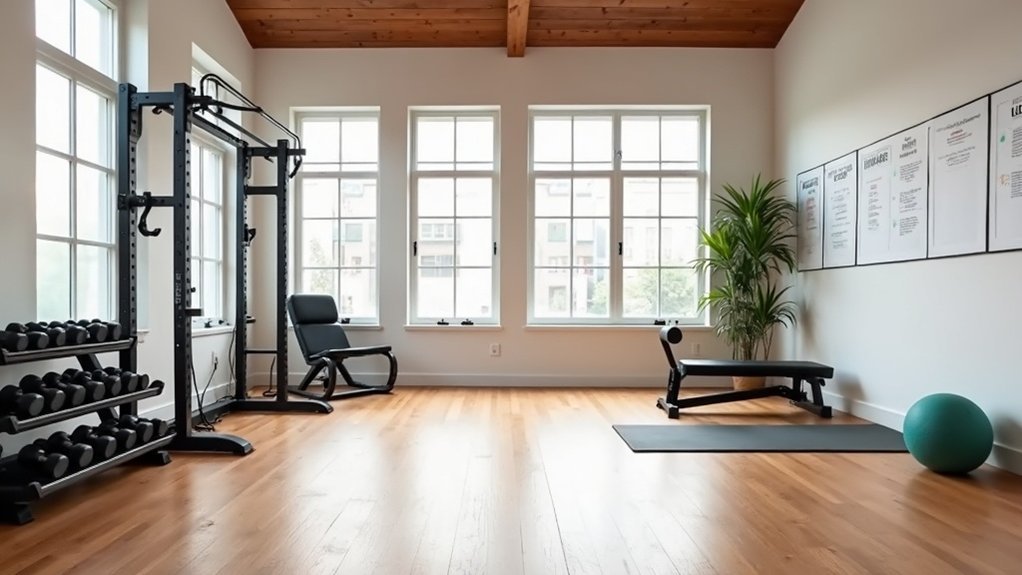
Start by investing in essential equipment like a sturdy bench, a set of dumbbells, a barbell with weight plates, and resistance bands to cater to all fitness levels. Aim for at least 100 square feet of space to perform exercises comfortably and safely.
Invest in key equipment like a bench, dumbbells, and a barbell, ensuring at least 100 square feet for safe workouts.
Incorporate a pull-up bar or a power rack for added versatility in your workouts, allowing you to switch between different exercises with ease. Adjustable dumbbells are perfect for saving space and accommodating varying intensities as you progress.
Finally, consider installing a full-length mirror to monitor your form, ensuring you maximize effectiveness and minimize injury during your PPL workouts.
With the right setup, you can create an inviting and efficient home gym that supports your health and fitness goals.
Sample Push-Pull-Legs Workout Schedule
To effectively structure your Push-Pull-Legs workout schedule, aim for a six-day routine that hits each muscle group twice a week.
This balanced training frequency is essential for muscle growth and recovery, especially when utilizing home gym equipment.
Here’s a sample workout plan tailored for both men and women:
- Day 1 & 4: Push – Focus on exercises like bench presses, shoulder presses, and triceps extensions using your home gym equipment to strengthen your upper body.
- Day 2 & 5: Pull – Prioritize bent-over rows, pull-ups, bicep curls, and face pulls to target your back and arms effectively.
- Day 3 & 6: Legs – Include squats, deadlifts, lunges, and calf raises to build lower body strength.
With this Push/Pull/Legs split, you’ll maximize your training sessions in your home gym, promoting health and fitness for everyone!
Effective Exercises for Each PPL Day
When structuring your Push Pull Legs routine for home workouts, it’s essential to choose effective exercises that can be done with minimal equipment.
For Push Day, consider incorporating push-ups and dumbbell shoulder presses; these exercises can be performed with just a pair of dumbbells or even bodyweight.
On Pull Day, focus on resistance band rows and dumbbell curls, which are great for building strength without the need for a gym.
Don’t overlook Leg Day, where bodyweight squats and lunges can significantly enhance your strength and muscle growth, all within the comfort of your home.
Essential Push Day Exercises
A successful Push Day workout at home revolves around a few essential exercises that effectively target your chest, shoulders, and triceps, all while utilizing home gym equipment.
Incorporating these movements will help enhance your upper body strength and muscle definition:
- Bench Press (with Dumbbells or a Barbell): Focus on your chest, shoulders, and triceps. Aim for 3 sets of 5-7 reps. If you don’t have a bench, you can perform this on the floor.
- Seated Dumbbell Shoulder Press: Develop shoulder strength with 3 sets of 6-8 reps. Use a sturdy chair or bench to support your back while you lift.
- Incline Dumbbell Press: Emphasize your upper chest by performing 3 sets of 8-10 reps. You can create an incline using a stable surface or a wedge if you don’t have an adjustable bench.
Don’t forget to include accessory exercises like Side Lateral Raises and Triceps Pressdowns to round out your Push Day routine effectively.
With the right home gym equipment, you can build a strong upper body without needing to go to the gym!
Key Pull Day Movements
While you may think of push exercises as the core of your upper body routine, essential pull day movements are just as crucial for balanced strength development, especially when working out at home.
Incorporating Bent-over Rows with your home gym equipment targets your upper back, while Pull-ups engage your lats and biceps effectively, even in a limited space.
For shoulder stability, include Face Pulls using a resistance band, which is a versatile tool for home workouts.
Barbell Shrugs can be performed with minimal equipment to effectively hit your trapezius muscles, and don’t forget to add Barbell or Dumbbell Curls to isolate those biceps.
These pulling muscles enhance your pull workout, ensuring a well-rounded upper body routine.
With these exercises, you’ll build strength and improve your overall performance right in the comfort of your home gym.
Effective Leg Day Routines
Leg day is crucial for building strength and stability in your lower body, especially when working out at home.
To maximize your home gym routine, here are three essential exercises for your leg workout:
- Squats: These target your quads, hamstrings, and glutes. You can perform bodyweight squats or use a kettlebell or dumbbell for goblet squats to add resistance.
- Romanian Deadlifts: This exercise effectively engages your hamstrings and glutes. You can use a barbell or dumbbells, making it flexible for your home gym equipment.
- Lunges: Incorporate reverse lunges or Bulgarian split squats to enhance your leg strength and stability. These can be done with or without weights, depending on your fitness level.
Tips for Progress Tracking and Recovery
To optimize your progress in the Push Pull Legs routine at home, it’s essential to consistently monitor your workout performance.
Make sure to prioritize rest days and adjust your training volume to fit your home gym setup.
This approach will aid in effective recovery while maximizing muscle growth.
Keep these strategies in mind to enhance your fitness journey from the comfort of your home and achieve your health and fitness goals.
Monitor Workout Progress
Tracking your workout progress is essential for achieving your fitness goals and optimizing your home training routine. Here are three effective ways to monitor your progress while working out at home:
- Use fitness tracking apps like Hevy to log your home workouts, monitor weight lifted, and identify patterns in your training volume, ensuring you make the most of your available equipment.
- Keep a workout journal to record exercises, sets, reps, and personal notes on your performance, recovery time, and how you feel during your at-home workouts. This can provide valuable insights to enhance your routine.
- Implement progressive overload by gradually increasing weights or reps with your home gym equipment to guarantee muscle adaptation, while scheduling deload weeks every 4-6 weeks to prevent overtraining and support your overall health.
This approach will help you stay on track and make necessary adjustments to your home fitness journey.
Prioritize Rest Days
While you’re pushing your limits in your Push Pull Legs routine at home, it’s crucial to prioritize rest days for optimal recovery and progress. Aim to incorporate one to two rest days each week, allowing your muscles to recuperate effectively.
On these rest days, consider active recovery strategies such as light stretching, yoga, or low-intensity cardio to enhance blood flow and support muscle repair without adding extra strain.
Additionally, track your performance and recovery metrics, including sleep quality and fatigue, to fine-tune your rest day scheduling.
Adjust Training Volume
Adjusting training volume is essential for maximizing your results with home gym workouts, especially in a Push Pull Legs routine. To effectively modify your training volume, keep these tips in mind:
- Aim for 10-20 sets per muscle group weekly to optimize hypertrophy, ensuring you’re getting the most from your home workouts.
- Incorporate progressive overload by gradually increasing weights by 2.5-5% as your strength improves, even with home gym equipment.
- Monitor your recovery by tracking your performance; if you notice increased fatigue or a decline in strength, consider reducing volume or adding extra rest days.
Utilize a training log or fitness app to keep track of your sets, reps, and weights. This practice will provide valuable insights into your progress and help you know when to adjust training volume for even better results in your home exercise regimen.
Adapting PPL for Different Fitness Levels
As you embark on your fitness journey at home, adapting a Push-Pull-Legs (PPL) routine to suit your fitness level is crucial for achieving your goals.
For beginners, focusing on bodyweight exercises is key; consider utilizing resistance bands to build foundational strength right in your living room.
Focusing on bodyweight exercises and resistance bands is essential for beginners to build strength at home.
As you move into an intermediate fitness level, start incorporating free weights and household items, adding compound movements such as dumbbell bench presses or even water bottles for resistance.
Advanced trainees can elevate their workouts by integrating supersets or using versatile tools like kettlebells.
If you find yourself with limited equipment, don’t hesitate to modify exercises—swap bench presses for push-ups or use a sturdy chair for tricep dips.
Always prioritize proper form and gradually increase intensity to optimize results, ensuring that all major muscle groups are effectively targeted while maintaining a healthy lifestyle from the comfort of your home.