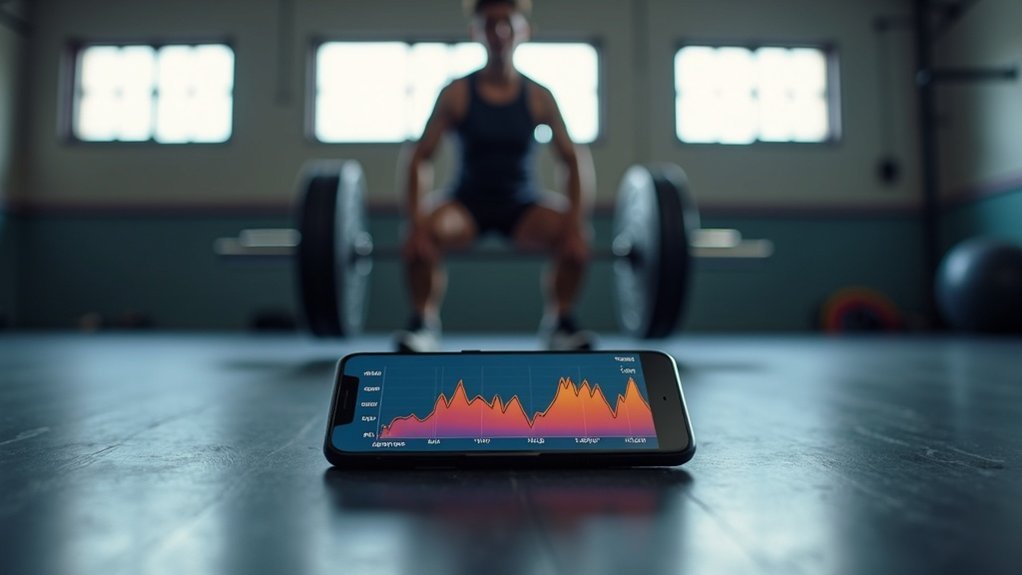
To analyze bar path with phone apps for your home gym workouts, start by downloading a suitable app like Metric VBT. Capture your lifts from the side to ensure accurate tracking, and toggle the bar path feature in the app’s settings. This tool will provide valuable insights into your lifting mechanics, enabling real-time feedback and adjustments to enhance your performance. Regularly review the data to identify any inconsistencies in your form, which will help improve both efficiency and safety during your home exercises. Explore additional tips to further optimize your barbell technique and elevate your at-home fitness journey.
Key Takeaways
- Download a mobile app like Metric VBT to track your bar path using your phone’s camera for free, making it easy to analyze your lifts from the comfort of your home gym.
- Record your lifts from a side angle to ensure accurate bar path analysis, which is crucial for improving your technique and maximizing your workouts.
- Enable the bar path feature in the app’s settings to track your performance during each lift, helping you to stay focused on your form.
- Regularly review the recorded data to identify any inconsistencies in your lifting technique, allowing you to make necessary adjustments for better results.
- Consider exploring additional apps like Iron Path or Keelo, which offer enhanced tracking features such as joint angles, to further optimize your home workout routine.
Understanding Bar Path
When you analyze bar path in the context of home workouts, you’re fundamentally examining the trajectory a barbell takes during various lifts, which can significantly impact your performance even in a home gym setting.
A consistent bar path is essential; it minimizes inefficient movements and maximizes force application, helping you get the most out of your home workouts.
Different lifts require distinct bar paths—squats should follow a straight line, while cleans may display an S shape.
Different lifts demand unique bar paths; maintain a straight line for squats and an S shape for cleans.
Utilizing bar path analysis through video recordings or tracking apps can help you identify technical flaws, enhancing your lifting mechanics right from the comfort of your own home.
This immediate feedback not only improves your technique but also reduces the risk of injury, ultimately elevating your overall performance and fitness journey in your home gym.
Measuring Bar Path With Mobile Apps
To effectively measure bar path during your home workouts, leveraging mobile apps can significantly enhance your training experience.
These apps provide precise tracking and analysis tools that allow you to optimize your performance. For instance, apps like FLEX Stronger and GymAware use specialized hardware to accurately track bar path, offering valuable insights into your barbell trajectory.
The Metric VBT app also includes a free feature that captures barbell movement through video, which can be beneficial for analyzing your lifting technique.
Analyzing Bar Path in Different Lifts
Using mobile apps to measure bar path is just the beginning; understanding how to analyze bar path in different lifts is essential for refining your home workout technique.
In the bench press, effective path tracking shows an arc from shoulders to chest, which you can easily practice with your home gym setup.
For squats, aim for a straight barbell path over the midfoot to maximize stability and effectiveness.
The deadlift requires a close-to-body path, avoiding deviations, which is crucial for maintaining form and preventing injury.
Olympic lifts, like the clean and snatch, exhibit an S-shaped trajectory that demands vertical alignment, making them challenging but rewarding to master.
Improving Bar Path Efficiency
Improving bar path efficiency is crucial for maximizing your lifting potential at home while minimizing the risk of injury. A consistent bar path not only enhances force and power but also reduces unnecessary side-to-side or rotational motion during your workouts.
By utilizing video analysis apps like Metric VBT, you can track your bar path in real-time, allowing for immediate corrective adjustments right from your home gym. Regularly monitoring your form during key lifts, such as squats and deadlifts, helps identify deviations that may hinder your progress.
Engaging with online resources and expert coaches from the home fitness community can further refine your technique. Small, incremental improvements in your bar path can lead to significant gains in strength and overall fitness, making your home workouts more effective.
Getting Started With Bar Path Tracking
How can you effectively track your bar path to enhance your lifting performance at home? Start by downloading the Metric VBT app for free on iOS.
Create or log into your profile, then navigate to the Account tab and toggle the bar path switch in Settings to apply it to all lifts. For accurate tracking, record your barbell lifts from a side angle, especially focusing on the snatch bar path.
Consider exploring additional apps like Iron Path or Keelo, which offer features like joint angle tracking to further refine your training.
Regularly review your data to identify any inconsistencies, enabling you to make technical adjustments and improve your lifting efficiency right in your home gym.