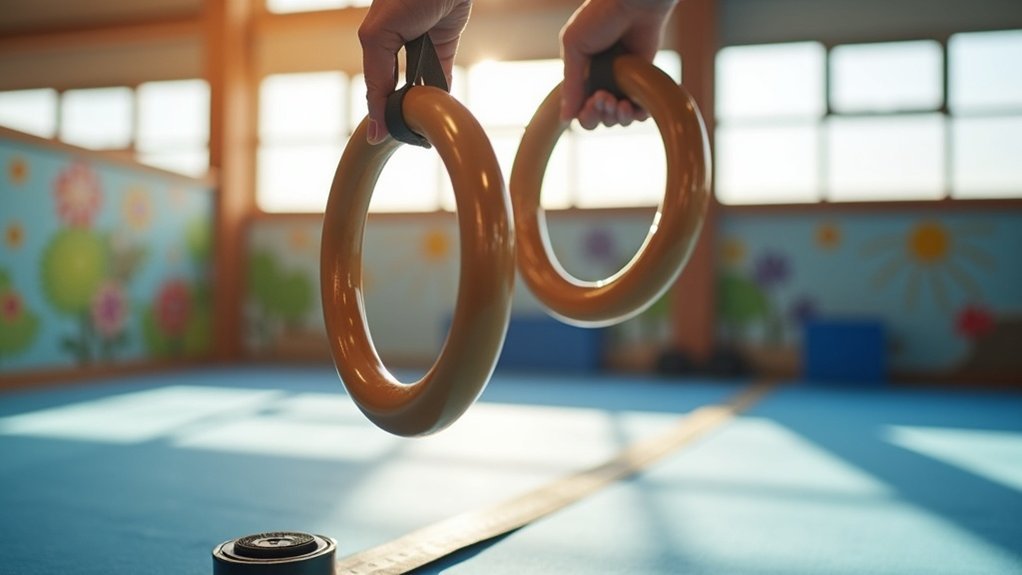
To set gymnastic rings at the proper height for your home gym, start by considering your specific exercise goals. Position the rings lower for push-ups, chest height for dips, and adjust them to a height slightly taller than you for pull-ups. Ensure they are securely set between 2.5 to 3.75 meters to maintain safety, and make sure your feet can comfortably touch the ground when your arms are extended. Regular maintenance of your setup is crucial for both safety and performance, so keep everything in check to achieve optimal results. Explore more tips to elevate your at-home workout routine!
Key Takeaways
- Assess your exercise needs to determine the ideal ring height based on the movements you plan to perform in your home gym setup.
- Position the rings lower for push-ups, at chest height for muscle-ups and dips, or between 2.75 to 3.75 meters for inverted hangs.
- Ensure the rings are securely mounted to heavy-duty points and regularly check straps for wear and stability to ensure your safety.
- Test the adjusted height with your intended exercises to confirm comfort and safety before you begin your workout.
- Maintain adequate clearance above your head for swinging movements, and ensure that your feet can touch the ground when your arms are extended for proper balance and control.
Assessing Exercise Requirements
When setting up gymnastic rings at home, it’s essential to first assess your exercise requirements.
Consider the height of the rings based on the movements you intend to perform. For push-ups, position the rings a few inches off the ground to ensure a full range of motion. If you’re aiming for muscle-ups or dips, set them around chest height for safety and optimal technique.
Consider ring height based on your exercises: low for push-ups, chest height for muscle-ups and dips, ensuring safety and technique.
For swinging or dynamic movements, ensure there’s enough clearance above your head to avoid any accidents. Test the adjusted height with your intended exercises to create the perfect setup, guaranteeing comfort and effectiveness in your at-home training.
Your fitness journey starts with thoughtful planning!
Determining Optimal Ring Height
When determining the ideal height for your gymnastic rings at home, consider the specific exercises you plan to perform.
For example, if you’re focusing on push-ups, you’ll want the rings set lower, while for more advanced moves like muscle-ups, a higher setup is necessary.
Always adjust the rings to suit your height and ensure they feel comfortable and stable before starting your workout.
This customization will help you maximize your home gym experience and support your fitness journey, regardless of your skill level.
Exercise-Specific Height Guidelines
Determining the ideal height for your gymnastic rings is essential for maximizing your workout effectiveness and safety at home.
For push-ups, set the rings a few inches off the ground to ensure a full range of motion.
For muscle-ups, position the rings around chest height for smooth transitions.
If you’re performing inverted hangs or top position holds, set the rings at 2.75 to 3.75 meters (9 to 12 feet).
For pull-ups and ring rows, adjust them to about a head taller than you.
Always test the height with your intended exercises and feel free to make adjustments to guarantee peak performance and safety during your home workouts.
Adjusting for User Height
To find the ideal height for your gymnastic rings at home, consider your height and the specific exercises you’ll be performing. Rings with adjustable straps make it easy to modify the height according to your needs. For exercises like push-ups, set the rings lower, while muscle-ups require them to be at chest height. Ensure there’s enough vertical clearance for a full range of motion. Here’s a quick guide:
| User Height | Ring Height |
|---|---|
| Under 5’6″ | 7-8 feet |
| 5’6″ – 6’0″ | 8-9 feet |
| 6’0″ – 6’3″ | 9-10 feet |
| Over 6’3″ | 10+ feet |
Make sure to test and adjust the height for your comfort and the best workout experience!
Using Adjustable Straps for Height Changes
Adjustable straps are a game changer for setting gymnastic rings at the perfect height for your home workouts. They enable quick height adjustments by simply clipping carabiners into different webbing sections, providing you with the flexibility needed for a variety of exercises.
To ensure symmetry and stability, always count the skipped webbing sections on both straps. Once you’ve set the desired height, use the buckle mechanism to loosen, adjust, and securely tighten the strap length to prevent any slippage during your workout.
It’s essential to test the adjusted height with your intended exercises and regularly inspect the straps and buckles to ensure they’re secure and free from wear. This way, you can confidently stay healthy and fit while exercising at home.
Safety Considerations for Ring Height
Once you’ve set up your gymnastic rings with adjustable straps, it’s crucial to assess their height for safety, especially in a home gym environment.
Ideally, position the rings between 2.5 to 3.75 meters (8 to 12 feet) to ensure a full range of motion. It’s important that when your arms are fully extended, your feet can touch the ground—this serves as a safety feature for beginners.
Position your rings 2.5 to 3.75 meters high, ensuring your feet can touch the ground for safety.
Always secure the rings to heavy-duty mounting points, such as reinforced ceiling joists, to prevent accidents.
Regularly inspect the straps and rings for any signs of wear or loosening, and make sure to test the stability of the setup before attempting any dynamic movements.
Prioritize your safety to enjoy a successful workout at home!
Testing Stability and Comfort
To ensure your rings are stable and comfortable for your home workouts, begin by gradually adding weight to them while monitoring for any unexpected movement.
Conduct a thorough visual inspection of your setup, ensuring that everything is evenly spaced and securely fastened.
Lastly, adjust the height and alignment to suit your comfort before diving into your exercise routine.
Stay safe and get ready to elevate your fitness journey at home!
Gradual Weight Testing
Testing the stability and comfort of your gymnastic rings is crucial for ensuring a safe and effective workout experience at home.
Begin with gradual weight testing by applying your body weight to the rings first. This initial step allows you to assess their stability before progressing to dynamic movements.
Be mindful of any creaking sounds or unexpected movements, as these could indicate issues with your rings setup. Always ensure that all adjustments are secure and that the rings remain evenly positioned during testing.
It’s important to conduct these tests not just during setup but also periodically afterward to maintain your confidence in the stability of your home gym equipment.
Staying healthy and fit while exercising at home requires reliable gear, so take the time to ensure your gymnastic rings are up to the task.
Visual Inspection Checklist
A thorough visual inspection of your gymnastic rings is essential for ensuring stability and safety during your home workouts.
Begin by checking that the straps are straight, untwisted, and securely threaded through the rings and anchor points. Test each anchor point by gradually applying weight; listen for any instability or creaking sounds.
Make sure the rings are adjusted to the same height for balanced movement. Confirm there’s adequate clearance above the rings—ideally 9-12 feet—to prevent any collisions.
Regularly inspect the straps for wear and fraying to guarantee they’re in good condition. These proper checks will help your home gym setup function effectively and keep you safe while exercising.
Adjust for Comfort
Once you’ve confirmed your gymnastic rings are securely set up, adjusting them for comfort is essential to maximizing your workout experience at home. Here’s how to do it:
- Set the rings so your feet can touch the ground when your arms are fully extended, ensuring stability and confidence as you exercise.
- Perform a few repetitions of your intended upper body exercises, paying attention to any discomfort or form issues that may arise.
- Measure from the ground to each ring’s base to ensure they’re at equal height, using the carabiner for quick adjustments.
Regularly check for stability by applying weight and listening for any creaks—this will help you safely enjoy your gym rings and optimize your workout for both comfort and effectiveness in your home gym!
Fine-Tuning for Specific Movements
When fine-tuning the height of gymnastic rings for specific movements at home, it’s essential to consider the unique demands of each exercise to maximize your workout efficiency. Here’s a quick reference table to help you adjust the height effectively for both men and women:
| Exercise | Ideal Height | Key Consideration |
|---|---|---|
| Push-ups | A few inches off the ground | Ensure full range of motion for optimal strength development |
| Muscle-ups | Chest height (2.5-3 ft) | Achieve a smooth transition from pull-up to dip for better performance |
| Inverted Hangs | 9-12 feet (2.75-3.75 m) | Maintain sufficient clearance for body movement and safety |
Always test each adjustment to guarantee comfort and effectiveness, as different exercises may require fine-tuning the rings’ height for your individual needs. Stay committed to enhancing your home workout routine and achieving your fitness goals!
Regular Maintenance and Adjustments
Maintaining your gymnastic rings is just as crucial as adjusting their height for various exercises, especially when working out at home.
Regular upkeep ensures safety and optimal performance. Here’s how to keep your rings in top shape:
- Weekly Inspections: Check the straps, rings, and anchor points for any signs of wear or fraying. This is essential for your safety.
- Height Adjustments: Modify the height of the rings as needed to allow for a full range of motion while ensuring that your feet don’t touch the ground during exercises.
- Testing Adjustments: After making adjustments, gradually apply your weight to test stability and listen for any unusual creaking sounds.
It’s a good idea to keep a record of any adjustments you make, as this will help you track changes over time.
Regular checks will prevent uneven strain during your workouts, ensuring your home training remains safe and effective for both men and women.